
Questions to Ask When Touring a Senior Living Community
Questions to ask on a senior living tour — care and staffing, safety, daily life, costs and contracts — what to verify independently, and a printable tour-notes checklist.

A senior living tour is designed to be pleasant. The lobby is bright, someone offers coffee, and the questions you meant to ask can slip away. Touring two or three communities on different days makes it worse: later you cannot remember which one had the activity calendar and which one mentioned the extra fee.
The answer is simple. Bring the same questions to every tour, and write down the answers in the same order. This guide is a list of those questions, and a printable page to write on.
It is not a ranking of communities and it does not say which kind of setting your parent needs. That is for your parent, your family and the clinicians involved to decide.
Know which kind of place you are visiting
"Senior living" is an umbrella, and the names do not mean the same thing everywhere. In general:
- Independent living is for people who do not need help with daily care and want housing designed for older adults, often with meals and activities.
- Assisted living provides housing plus help with daily tasks such as bathing, dressing and medications, in a residential setting.
- Memory care is for people living with dementia. It may be a separate wing of a community or a community of its own.
- A nursing home provides nursing and medical care around the clock. Some nursing homes are Medicare-certified, and Medicare uses the term skilled nursing facility for a certified facility that provides short-term skilled care. The two terms are not interchangeable, so ask a nursing home what it is licensed and certified as.
These are not regulated in the same way. For assisted living, state governments set and enforce the licensing standards, and states take different approaches, so the same word can describe very different places. Ask each community what it is licensed as in your state and what that license allows it to do. Do not assume anything about a setting from its category.
Medicare does not cover long-term care, also called custodial care: mainly help with daily tasks such as bathing, dressing and meals, whether it is received in a nursing home, in assisted living or at home. Medicare may cover a limited period of skilled nursing facility care (opens in a new tab) in specific circumstances, such as after a qualifying hospital stay when a doctor decides daily skilled care is needed. That is short-term care, which is different from long-term custodial care. Medicaid may help with the cost of some long-term care, and its rules depend on the state. Ask each community what payment sources it accepts.
Ask about the care they provide
- What level or levels of care do you offer? Which needs can you meet, and which can you not?
- How is a new resident's need for care assessed, and by whom? How often is it reassessed?
- What happens if my parent's needs increase? Can they stay, and what changes? What would lead to a move to another setting?
- Who gives medications, and who oversees them?
- Is a nurse on site, and when? Who is in charge when the nurse is not?
- What is your approach to residents with memory loss, if that matters for us?
- What do you do if a resident falls or is taken ill, at any hour?
Ask about staffing
- How many staff are on each shift, including nights and weekends, and how many residents do they care for?
- How long have the director and the care staff been here? How often is staff turnover a problem?
- Are staff employed by the community or by an outside agency?
- How can I reach a person in charge on evenings and weekends?
- Who trains staff, and in what?
Watch for yourself, too. Do staff greet residents by name? Do residents look engaged? Is a call light answered?
Ask about daily life
- What does a typical day look like? May I see the activity calendar for this month?
- What do meals look like? Can a resident with a special diet be accommodated? May I eat a meal here?
- How do residents get to appointments, shopping and activities outside? Is transportation included, or does it cost extra?
- Can a resident keep their own doctor?
- Is the building easy to move around in for someone who uses a walker or a wheelchair, including the bathrooms, doors, halls and outdoor spaces?
Ask about safety and emergencies
- What happens in a medical emergency, and who decides to call 911?
- How do you handle power outages, severe weather or evacuation?
- How are residents who wander kept safe?
- How are residents' belongings and medications secured?
- How are concerns or complaints from residents or families handled?
Ask about family communication and visiting
- How will you tell us about a change in my parent's health or needs? Who calls us, and how fast?
- Are there care meetings with families? How often?
- What are the visiting policies, and are they different for evenings, overnight or in an emergency?
- Who is our main contact?
Ask about costs and the contract
Costs are covered in more detail in the companion guide, How to Compare Senior Living Options and Understand Costs. On a tour, ask at least:
- What is the monthly charge, and what exactly does it include?
- What costs extra, such as levels of care, meals, transportation, laundry or medication management?
- Are there one-time fees, such as a community fee or a deposit? Are any refundable, and under what conditions?
- How, and how often, do charges go up? How much notice is given?
- May I take a copy of the contract and every fee schedule home?
Ask for the answers in writing, including a written fee schedule and, if your parent has been assessed, a written estimate. A figure said aloud on a tour is worth confirming in writing.
Ask about moving in and moving out
- What does move-in involve, and how long does it take?
- What notice is required to leave? What charges apply after a resident moves out or dies?
- Under what circumstances can the community ask a resident to leave, and what notice is given?
Check what you were told
A single tour is one data point. You see one day, one route through the building and the people you are introduced to. Check what you were told against other sources:
- Your state's licensing agency. Ask the community for its license, and check with the state agency that issues it. The agency's name differs from state to state. Ask whether inspection or survey records are available for the community and how to see them. What exists differs by state and by type of setting.
- The long-term care ombudsman, if you wish. Every state has a Long-Term Care Ombudsman Program, which advocates for residents of nursing homes, assisted living and similar communities, including investigating complaints. Contacting it is optional, not a step you must take before choosing.
- Care Compare, for nursing homes. Medicare's Care Compare tool lets you search Medicare-certified nursing homes and compare staffing and quality of care at them.
- The Eldercare Locator, which can connect you to local agencies on aging.
Printable tour-notes checklist
Print one copy for each community you visit. Write the community name and date at the top, and write the answers beside each item.
Community basics
- Name, address and tour date
- Type of setting and what it is licensed as in this state
- Contact person and phone number
Care
- Levels of care offered, and who assesses and how often
- What happens if needs increase
- Who gives medications, and nurse hours
- Approach to memory loss, if it matters to us
- Response to a fall or illness at any hour
Staffing
- Staff on each shift, including nights and weekends
- Employed by the community or by an agency
- Turnover and how long the director has been here
- Who to reach on evenings and weekends
Daily life and accessibility
- Sample activity calendar seen
- Meals and special diets, and a meal tried
- Transportation, and what it costs
- Building accessible for a walker or wheelchair
Safety and communication
- Emergency and evacuation plans
- Wandering and security
- How families are told about changes
- Visiting policies and care meetings
Costs and contract
- Monthly charge and what it includes
- Costs that are extra
- One-time fees, and whether any are refundable
- How and when charges increase
- Copy of contract and fee schedule taken home
- Notice and charges for moving out, and when a resident can be asked to leave
What I checked myself
- License confirmed with the state agency
- Inspection or survey records reviewed, where available
- Ombudsman contacted, if we chose to
- Care Compare checked, if a nursing home
- Reminder: one tour is one data point
Sources and further reading
Fayzain Media is independent. We are not affiliated with Medicare, CMS or any government agency. These are the official sources this guide draws on.
- Finding a Nursing Home — Centers for Medicare & Medicaid Services (opens in a new tab)
- Long-term care — Medicare (opens in a new tab)
- Skilled nursing facility (SNF) care — Medicare (opens in a new tab)
- Long-Term Care Ombudsman Program — Administration for Community Living (opens in a new tab)
- Assisted Living: Examples of State Efforts to Improve Consumer Protections — U.S. Government Accountability Office (opens in a new tab)
- Eldercare Locator — Administration for Community Living (opens in a new tab)
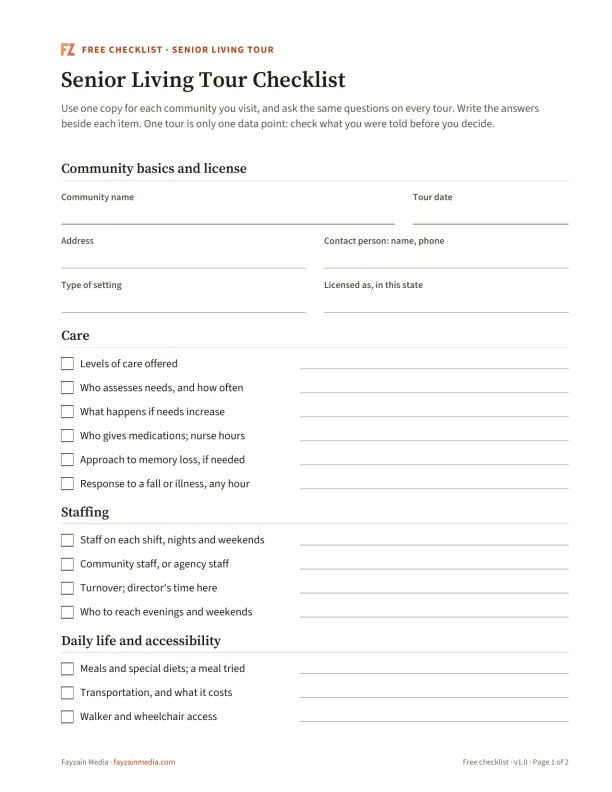
Free printable
Senior Living Tour Checklist
A two-page printable worksheet for one senior living tour: the basics and license, care, staffing, safety, costs and fees, the documents to ask for, and what to check yourself, with room to write the answers.
Free. No email or signup required.
Where to go next
- How to Compare Senior Living Options and Understand Costs
After the tours, set the communities side by side and get the costs and contract terms in writing.