
Questions to Ask Before Your Parent Leaves the Hospital
What to ask the care team, and what to get in writing, before a parent is discharged from the hospital — medications, follow-up care, equipment, help at home and who to call.

Discharge planning is meant to be a conversation, but it often feels like a hallway. A parent is told they are going home today, a nurse hands over a folder, and the questions that matter only occur to you in the car.
This guide is a list of questions to ask the care team before that moment, and of what is worth getting in writing. It is about organizing what the clinicians tell you. It does not replace their advice, and it does not suggest what your parent's care should be.
Start asking before discharge day
Medicare's discharge planning checklist describes the patient and a caregiver as important members of the planning team, and suggests using the checklist throughout a stay rather than on the last morning. It names the people to talk to: the doctor, a discharge planner, a social worker or a nurse.
If your parent is still in the hospital, ask who the discharge planner or social worker is today, and when you can talk with them. Everything below gets easier with a day's notice.
Ask where your parent will get care next
"Going home" is not always the whole plan. Ask:
- Where will care happen after discharge? Are there options, such as home health care, and what do the staff recommend?
- Which tasks will your parent need help with at first: bathing, dressing, using the bathroom, climbing stairs, cooking, shopping, paying bills, getting to appointments or picking up prescriptions?
- Is your parent ready for those tasks as they are now, according to the care team?
Say what your parent prefers. Medicare's checklist suggests telling the staff which option the patient prefers, and asking directly about what the staff believe they will be ready to do.
Get the instructions in writing
Ask for written discharge instructions that you can read and understand, and for a summary of your parent's current health status. Medicare's checklist suggests bringing both, with the medication list, to follow-up appointments.
The Agency for Healthcare Research and Quality (AHRQ) also publishes a guide for patients leaving the hospital (opens in a new tab), with space to keep track of medicines, appointments and phone numbers.
If anything in the paperwork does not match what you were told out loud, ask about it while you are still there. A question answered on the ward is much easier than one that has to go through a phone line later.
Check the medication list with the care team
Medication is where confusion tends to land, and where it matters most to ask a professional rather than work it out yourselves.
- Write down every prescription medicine, over-the-counter medicine, vitamin and herbal supplement your parent takes, including what they took at home and what was added or changed during the stay. Medicare's checklist has a drug list page for this.
- Review that list with the staff and ask which items, and at what dose or strength, your parent should continue after leaving. Do not decide this yourselves.
- Ask them to share the updated list with your parent's other health care providers, or ask whether you should.
- Ask what each medicine is for, if you do not know.
If the list you are handed and the medicines in the bag do not agree, say so before you leave.
Ask about follow-up appointments and anything still pending
- Which follow-up appointments are needed, with whom, and who books them?
- Are any tests or results still pending, and who will tell you the results?
- Which questions should wait for the primary care doctor, and which should go to a specialist?
Write the appointments down with dates and times. If nothing is booked yet, ask what you should do and by when.
Ask about equipment and help at home
- Will your parent need medical equipment, such as a walker? If your parent has Medicare, ask whether it is covered, and who will arrange the delivery.
- Will your parent need home health care? Medicare covers home health only in certain circumstances, so ask the discharge planner or social worker what applies to your parent rather than assuming.
- If a task needs special skill, such as changing a bandage or giving a shot, ask the staff to show you and your parent, and then practice it with them watching, as Medicare's checklist suggests.
- Ask a social worker or the health plan what insurance is expected to cover and what you may have to pay.
- Ask about community services, such as home-delivered meals and rides to appointments. Your local Area Agency on Aging is one place to start, and the Eldercare Locator in the sources below can help you find it.
Ask what to watch for, and who to call
Ask the care team what complications to watch for and what to do about each one. Their answer for your parent, after this stay, is far more useful than general advice you find elsewhere.
Write down the names and phone numbers of the people to call with questions or concerns. Ask what the best number to call after discharge is, and when to use it: for example, whether it is answered at night and on weekends, and what to do if no one picks up. If you think something is an emergency, call 911.
Sort out the practical details of getting home
- How will your parent get home, and is that actually arranged?
- Who will be with them at first?
- Can you collect prescriptions and any special food before your parent leaves, so you do not make extra trips? Medicare's checklist suggests doing errands like these ahead of discharge.
- Is there anything your parent needs in the house tonight that is not there yet?
If you think discharge is happening too soon
People with Medicare have the right to ask for a fast appeal if they think they are being asked to leave a hospital or other care setting too soon. Medicare's checklist says hospital staff should give a notice called the "Important Message from Medicare" that explains how, and says to ask for it if you do not get one. The notice, and Medicare's page on the right to a fast appeal (opens in a new tab), explain the steps and the deadline, which is tied to the day of discharge, so ask about the notice as soon as you have a concern. If your parent has a Medicare Advantage Plan, different rules apply, and the notice and the plan explain them. The care team and the number on the notice are the place to ask how it applies to your parent.
Printable discharge checklist
Print this page, or copy the questions onto paper, and write the answers beside each. Skip anything that does not apply.
Who to talk to
- Name and phone number of the discharge planner or social worker
- Name and phone number of the nurse or doctor to call with questions
- Best number to call after discharge, and when to use it
Where care will happen next
- Where care will happen after discharge, and what the options are
- Which daily tasks your parent will need help with at first
- Who will help, and who is there the first night
- How your parent is getting home
Paperwork to get before leaving
- Written discharge instructions, in language you understand
- A summary of your parent's current health status
- The medication list, written down, including anything new or changed
- The care team's answers to your questions, in writing where possible
Medications to confirm with the care team
- Which medicines to continue, at what dose or strength
- Which medicines are new, changed or stopped
- Whether the updated list has been sent to your parent's other providers
- Whether prescriptions are filled and in hand before leaving
Follow-up care
- Follow-up appointments: who, when, and who books them
- Tests or results still pending, and who will report them
- What to ask the primary care doctor and what to ask a specialist
Equipment and services
- Medical equipment needed, who delivers it and when
- Home health or other services, and whether the referral has been made
- A demonstration of any special task, with you practicing it back
- What insurance is expected to cover, asked of a social worker or health plan
Warning signs
- Complications the care team says to watch for
- What to do about each one, in their words
- Who to call, and when to call 911
Sources and further reading
Fayzain Media is independent. We are not affiliated with Medicare, CMS or any government agency. These are the official sources this guide draws on.
- Your Discharge Planning Checklist — Medicare (PDF) (opens in a new tab)
- Home health services — Medicare (opens in a new tab)
- Taking Care of Myself: A Guide for When I Leave the Hospital — AHRQ (opens in a new tab)
- Your right to a fast appeal — Medicare (opens in a new tab)
- Eldercare Locator — Administration for Community Living (opens in a new tab)
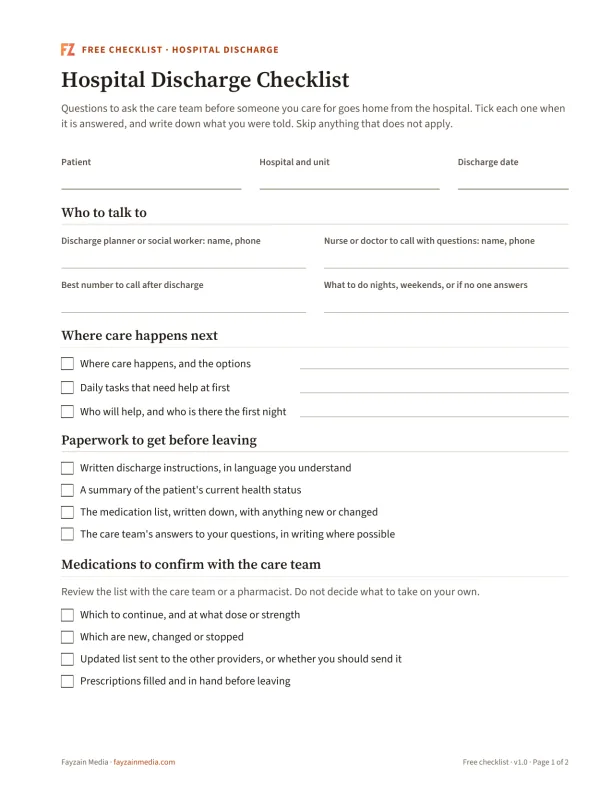
Free printable
Hospital Discharge Checklist
A two-page printable checklist of questions to ask the care team before someone goes home from the hospital, with room to write down contacts, paperwork, follow-up, equipment, warning signs and getting home.
Free. No email or signup required.
Where to go next
- Organizing the First Week Home After Hospitalization
Once your parent is home, set up one place for the paperwork, appointments and open questions.